T5-TBVAC

/

Project Overview

T5-TBVAC: Evaluating a multi-valent aerosol booster TB Vaccine for adolescent and young adults in diverse African settings.


In the T5-TBVAC project we will move beyond state-of-the-art in 3 ways. First, we will diversify the TB vaccine pipeline by developing the first multivalent recombinant viral vector TB vaccine candidate, ChAdOx1 T5, as a subunit booster vaccine for adolescents and young adults. We will compare immunogenicity between contrasting UK, West and East African settings. Second, ChAdOx1 T5 will be the first candidate TB vaccine delivered by aerosol in sub-Saharan Africa with bronchoscopic monitoring of lung immunity. Third, we will transfer an established and validated controlled human infection model (CHIM) to Uganda to compare ChAdOx1 T5 protective efficacy between rural and urban Uganda and the UK.

ChAdOx1 T5 expresses 5 mycobacterial antigens, each protective when delivered alone. Boosting prior BCG with ChAdOx1 T5 confers significant protection in mice and non-human primates. We will manufacture GMP ChAdOx1 T5 and conduct a UK first-in-human phase 1 clinical trial, followed by phase 2a trials in Senegal and Uganda, to determine the safety and immunogenicity of ChAdOx1 T5 when delivered either by aerosol or intramuscularly. We will use the skin BCG CHIM to evaluate the efficacy of ChAdOx1 T5 after either aerosol or intramuscular delivery in Uganda and the UK. Using a CHIM will significantly de-risk future, late-stage development of this and other candidate TB vaccines. A comprehensive analysis of immunological samples taken prior to BCG challenge will allow identification of immune correlates of protection which will support development of this and other candidate vaccines. Community engagement and involvement will guide our research processes and build population preparedness for new TB vaccine implementation. Capacity strengthening will be embedded in all that we do. This project will develop the next generation TB subunit aerosol booster vaccine, de-risk its late-stage development and establish a strong South-South-North collaborative partnership for future TB vaccine R&D.

Objectives

The key objectives of this project are as follows:

 1.  To manufacture a next generation virally vectored TB vaccine candidate, ChAdOx1 T5, under Good Manufacturing Practice (GMP) conditions and conduct        a Good Laboratory Practice (GLP) murine toxicology study to support regulatory applications for clinical trials.

 2.  To engage with stakeholders at national, community, research participant and patient levels to build understanding of TB vaccines, and of cutting-edge              approaches to accelerate new TB vaccine development.

 3.  To evaluate the safety and immunogenicity of ChAdOx1 T5, delivered either by aerosol or intramuscular (IM) injection, in a series of phase 1/2a clinical            trials across distinct settings in the UK, Uganda and Senegal; and to transfer an established BCG controlled human infection model (CHIM) to Uganda to          identify an early signal of efficacy in comparative trials in urban versus rural Uganda, and the UK.

 4.  To strengthen capacity in clinical trials, immuno-monitoring, vaccine product development and CHIMs in Uganda and Senegal, and to work in partnership          with the African Union (AU) and European Union (EU) to contribute to the AU-EU Innovation Agenda.

 5.  To build a strong South-South/South-North collaborative Scientific Leadership and Project Management team.

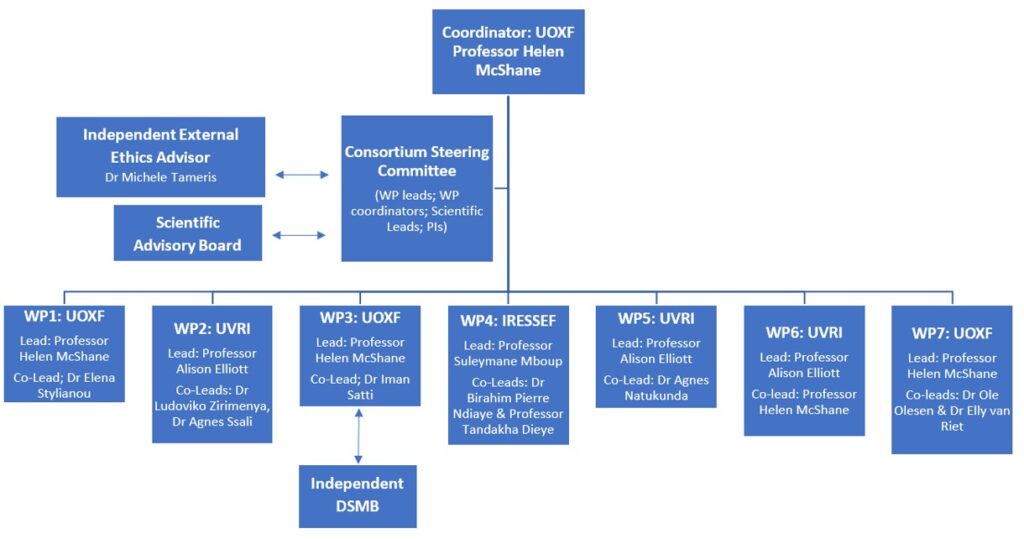
Governance Structure


Work Packages

Work package 1:  GMP Vaccine Manufacturing and Toxicology

WP1 will address Objective 1: To manufacture a next generation virally vectored TB vaccine candidate, ChAdOx1 T5, under GMP conditions, and conduct a GLP murine toxicology study to support regulatory applications for clinical trials.

Work package 2:  Community, Patient and Public Involvement and Engagement (CPPIE); Trial Planning and Preparation

WP2 will address Objective 2: To engage with stakeholders at national, community, research participant and patient levels to build understanding of TB vaccines, and of cutting-edge approaches to accelerate new TB vaccine development. This work will include the co-design and co-creation of the final protocol and all participant-facing documents. These documents will be used to prepare for WP3.

Work package 3: Clinical and Immunological Evaluation of ChAdOx1 T5

WP3 will deliver Objective 3, to evaluate the safety and immunogenicity of ChAdOx1 T5, delivered either by aerosol or by intramuscular (IM) injection, in a series of phase 1/2a clinical trials across distinct settings in the UK, Uganda and Senegal; and to transfer an established BCG controlled human infection model (CHIM) to Uganda to identify an early signal of efficacy in comparative trials in Uganda and the UK.

Work package 4: Capacity Strengthening and Networking

WP4 will address Objective 4: To strengthen capacity in clinical trials, immuno-monitoring, vaccine product development and CHIMs in Uganda and Senegal, and to work in partnership with the African Union (AU) and European Union (EU) to contribute to the AU-EU Innovation Agenda.

Work package 5:  Data and Output management, Dissemination, Exploitation and Communication

WP5 will be responsible for data management and the management of all other research outputs, and for ensuring the impact of these research outputs via dissemination, exploitation and communication. WP5 thus underpins the overall success of the T5 TBVAC consortium.

Work package 6, 7 and 8 will address Objective 5: to build a strong, trilateral, South-South/South-North collaborative Project Management and Scientific Leadership team.

Work package 6:  Scientific Leadership

WP6 will see the formation of a consortium Steering Committee (SC) and external Scientific Advisory Board (SAB). Both groups will meet regularly and provide feedback to the consortium.

Work package 7:  Project Management

WP7 will provide overarching Project Management led by UOXF and supported by TBVI.

Work package 8:  Ethics Requirements

The objective is to ensure compliance with the ‘ethics requirements’ set out in this work package. An independent external ethics advisor has been assigned to support all trials within the project.

Consortium Partners & Coördinator

University of Oxford, United Kingdom – : The Jenner Institute, part of the Nuffield Department of Medicine (NDM) at the University of Oxford, is a world-leading centre for vaccine research and development, with expertise spanning discovery science, translational research, vaccine manufacturing, and clinical evaluation. The Institute has played a leading role in the development of vaccines for major infectious diseases, including malaria, tuberculosis, Ebola, and COVID-19, and maintains extensive partnerships with academic, clinical, industry, and global health organisations worldwide.

As the Coördinator for this consortium, the University of Oxford provides overall coordination and strategic oversight through Professor Helen McShane, a globally recognised leader in translational vaccinology and clinical vaccine development. Professor McShane’s extensive experience in leading international vaccine research programmes and multi-partner collaborations helps ensure the consortium delivers high-quality science with global impact.

Uganda National Health Research Organisation (UNHRO), Uganda:

The Uganda National Health Research Organisation is a semi-autonomous organisation within the Uganda Ministry of Health. UNHRO is charged with stewardship and oversight of health research in Uganda, delivered through its research institutes, including the Uganda Virus Research Institute (UVRI). As the Scientific Lead for T5-TBVAC, UNHRO coordinates the delivery of research implemented by the Medical Research Council/Uganda Virus Research Institute & London School of Hygiene & Tropical Medicine Uganda Research Unit (MRC/UVRI & LSHTM Uganda Research Unit), which is hosted by the Uganda Virus Research Institute (UVRI). The Unit brings internationally recognised expertise in infectious disease research, clinical trials, and vaccine research,while UVRI is world-renowned for virus discovery and research, and is a key focus of the Government of Uganda’s investment in vaccine development capacity.

T5-TBVAC work at UVRI and the MRC/UVRI& LSHTM Uganda Research Unit will be led by Professor Alison Elliott and colleagues in the Immunomodulation and Vaccines research group whose goal is to understand population differences in immunity and health and to develop interventions to optimise outcomes. A particular focus is to understand why vaccine responses and efficacy differ between high income and low income, and urban and rural, settings and how this challenge can be addressed.

Reseau Africain DE Recherche en Sante (IRESSEF), Senegal:

IRESSEF (Institut de Recherche en Santé, de Surveillance Épidémiologique et de Formation) is a Senegalese non-profit health research institute, unique in its field in West Africa. It specializes in clinical trials, biomedical research, epidemiological surveillance, and scientific training. The institute contributes to the response to priority infectious diseases, including COVID-19, HIV, and tuberculosis.

Within the T5 TBVAC project, IRESSEF contributes to Work Packages (WP2 to WP7). It leads Study 4 of WP3, which evaluates the safety and immune response of the ChAdOx1 T5 vaccine candidate in Senegal. The institute is responsible for participant recruitment and follow-up, data collection, biological sample management, and related regulatory activities.

IRESSEF also leads WP4 on capacity strengthening, through the coordination of clinical and laboratory training activities and support for researchers’ development. The institute further contributes to data management, scientific dissemination, and project governance.

Through its involvement in T5 TBVAC, IRESSEF supports the development of new tuberculosis vaccines and contributes to strengthening clinical research and vaccinology capacity in Africa.

TuBerculosis Vaccine Initative (TBVI), the Netherlands:

The TuBerculosis Vaccine Initiative (TBVI is a non-profit foundation that facilitates the discovery and development of new, safe and effective tuberculosis (TB) vaccines that are accessible and affordable for all people. TBVI brings together partners from around the world by creating an enabling environment for TB vaccine research & innovation and product development, with the ultimate goal to relieve the burden of TB. In the T5-TBVAC project TBVI will be responsible for the qualitative work related to community, patient & public involvement and engagement (CPPIE), will design and organize a vaccine workshop to enable capacity strengthening and networking. Further, TBVI will prepare and manage the Plans for Dissemination, Exploitation and Communication as well as for Risk management and vaccine access and be involved in actions related to those plans as well as the management of the project.

Publications & News

Acknowledgement